
Many workers know something feels wrong at work. But what type of treatment counts as discrimination at work? Whether it’s being overlooked, left out, or treated unfairly, it can be difficult to recognise when everyday mistreatment crosses a legal line.
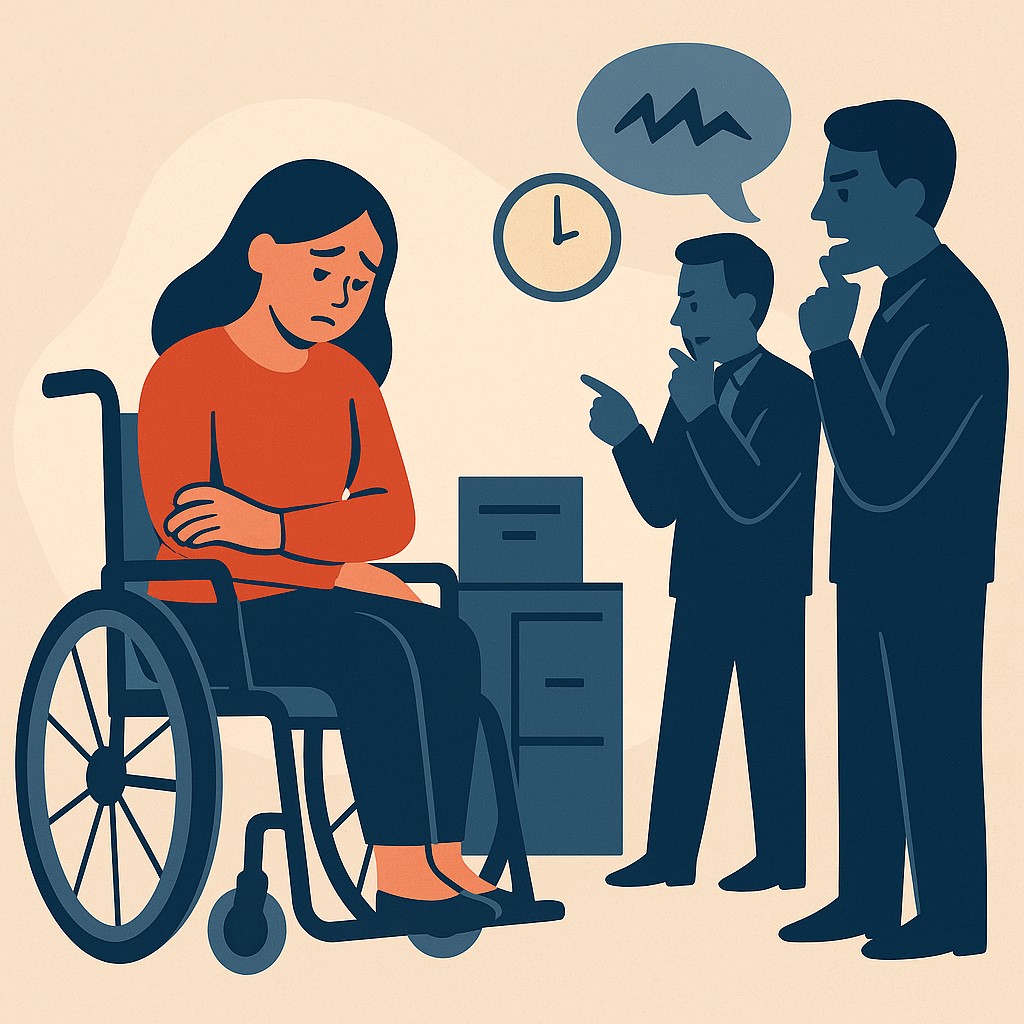
This guide explains the different forms of workplace discrimination, the legal protections in place under the Equality Act 2010, and what you can do if you think you’re being targeted.
What is Discrimination in the Workplace?
In the workplace, everyone has the right to be treated fairly. The Equality Act 2010 protects individuals from discrimination based on a defined set of characteristics. Discrimination arises when someone is treated differently or unfairly because of one of these legally protected characteristics.
Although the UK is broadly diverse, misconceptions and unconscious bias can still affect workplace culture.
Discrimination can leave employees feeling excluded or targeted, damaging their mental wellbeing and the overall health of the work environment. If ignored, it can create a toxic workplace with poor morale, increased staff turnover, and reputational damage.
Understanding Protected Characteristics
The Equality Act 2010 outlines nine protected characteristics:
- Age
- Disability
- Gender reassignment
- Marriage and civil partnership
- Pregnancy and maternity
- Race
- Religion or belief
- Sex
- Sexual orientation
It is unlawful to discriminate against anyone on the basis of any of these characteristics in the workplace, in public, in education, or when accessing housing or services.
[Source: https://www.legislation.gov.uk/ukpga/2010/15/section/4]
Types of Discrimination at Work
Discrimination at work can take several forms. Some are direct and obvious, while others are more subtle or systemic.
Direct Discrimination
Direct discrimination happens when someone is treated less favourably because of a protected characteristic. This type of discrimination is often easier to identify because the treatment is clearly linked to an individual’s identity or status.
Example: A woman is rejected from a promotion because the employer assumes she may soon go on maternity leave.
Even if the discriminatory action was based on a stereotype rather than actual fact, it still counts as unlawful direct discrimination.
Indirect Discrimination
Indirect discrimination arises when an organisation applies a rule, policy, or practice equally to everyone, but it puts people with a protected characteristic at a disadvantage.
Example: A company requires all employees to work late evenings, which disadvantages employees with caring responsibilities, particularly women.
The policy may appear neutral, but if it disproportionately impacts certain groups and isn’t justified as a proportionate means of achieving a legitimate aim, it is unlawful.
Harassment
Harassment is unwanted behaviour related to a protected characteristic that has the purpose or effect of violating someone’s dignity or creating an intimidating, hostile, degrading, humiliating, or offensive environment.
Example: An employee is regularly mocked about their accent or attire linked to their ethnic background.
This type of behaviour doesn’t need to be directed at the individual affected. Witnessing such conduct can also amount to harassment if it creates a hostile environment.
Bullying at work and harassment are often used interchangeably. However, harassment refers to unwanted conduct linked to one of nine protected characteristics. For example, bullying based on gender would be classed as harassment under the Equality Act 2010, giving you the right to raise a discrimination complaint.
Victimisation
Victimisation in the workplace occurs when someone is treated unfairly because they’ve made a complaint of discrimination, supported someone else’s complaint, or raised related concerns. It is unlawful to penalise someone for exercising their rights under the Equality Act.
Example: An employee is given fewer opportunities after acting as a witness in a colleague’s discrimination grievance.
Victimisation protections apply regardless of whether the original complaint is upheld – what matters is that the employee acted in good faith.
[See Equality Act 2010, Sections 13–27: https://www.legislation.gov.uk/ukpga/2010/15/part/2/chapter/2]
Examples of Discrimination at Work
If you’re treated unfavourable or disadvantaged because of a protected characteristic, it’s likely you’re being discriminated against.
Here’s a run down of the most common examples of discrimination that employees can encounter:-
Disability Discrimination
Disability discrimination occurs when a person is treated unfairly because of a physical or mental impairment. This includes both visible and invisible conditions, such as chronic illnesses and mental health disorders.
Under the Equality Act 2010, a mental health condition qualifies as a disability if it has a substantial, long-term impact on a person’s ability to carry out normal day-to-day activities. Employers are required to make reasonable adjustments, which may include modified duties, flexible hours, or workload adjustments.
Examples of disability discrimination at work include:-
- Refusing reasonable adjustments, such as remote working or assistive technology.
- Penalising absences related to a mental health condition.
- Withdrawing job or promotion offers upon learning of a disability.
- Creating a hostile environment through mocking or exclusion.
Pregnancy and Maternity Discrimination
This form of discrimination applies from the beginning of pregnancy until the end of maternity leave. Common issues include unfair selection for redundancy, refusal of time off for antenatal appointments, or changes to working hours without consultation.
Employees do not have to provide proof of pregnancy to be protected. Employers must not make assumptions or take adverse action based on perceived inconvenience.
See Also: Pregnancy rights at work
Gender Discrimination
Gender discrimination includes unequal treatment based on someone being male, female, or non-binary.
Examples of gender discrimination at work include:-
- Paying women less for the same role.
- Denying flexible work to mothers while granting it to fathers.
- Overlooking qualified candidates due to gendered assumptions about leadership ability.
It also encompasses sexual harassment, including unwanted comments, gestures, or physical contact.
See Also: Gender discrimination at work
Racial Discrimination
Racial discrimination includes unfair treatment based on race, ethnic origin, nationality, or skin colour.
Examples of racial discrimination at work include:-
- Bias in recruitment or promotion.
- Being overlooked for projects or excluded from teams.
- Offensive remarks, even when framed as jokes.
Employers must take all reports of race-based misconduct seriously and respond appropriately to prevent escalation.
Religious Discrimination
Unfair treatment based on religion or belief includes denying reasonable time off for religious observance, objecting to religious clothing, or failing to accommodate dietary requirements during events.
Examples of religious discrimination at work include:-
- Applying a dress code that indirectly discriminates against ethnic hairstyles or traditional attire without justification.
- Rejecting a candidate with a non-English sounding name despite them meeting all job criteria.
- Assigning less favourable tasks or excluding staff from meetings based on race or cultural background.
Employers should be flexible and open to adjustments unless doing so would cause undue hardship. A zero-tolerance approach to religious bias is essential in diverse workplaces.
Impact of Discrimination and Prejudice
Discrimination affects the targeted individual and the broader workplace. Employees may experience stress, anxiety, and burnout. Teams may suffer from poor morale and communication. For employers, unchecked discrimination leads to reputational damage, employment tribunal claims, and difficulty attracting and retaining talent.
The Law and Workplace Discrimination
Employers must comply with several legal duties:
- Equality Act 2010 – Core legislation protecting against discrimination.
- Section 26: Harassment
- Section 27: Victimisation
- Section 39: Discrimination in employment
- Health and Safety at Work etc. Act 1974 – Requires employers to ensure, so far as reasonably practicable, employees’ health, safety, and welfare. Section 2
Employer’s Duty of Care
Employers have a duty of care to take reasonable steps to prevent discrimination, promote inclusive policies, and create a safe workplace with e. Failure to do so can result in legal claims, financial penalties, and high staff turnover. Employers should provide training, update policies, and take action against unacceptable conduct.
What to Do if You’re Facing Discrimination in the Workplace
- Speak to your manager or HR about your concerns.
- Raise a formal grievance if necessary.
- Keep a record of incidents, dates, and witnesses.
- Seek legal advice if the issue persists.
- Consider a tribunal claim if internal processes fail.
You can find guidance on the grievance process from ACAS.
Legal Recourse if Your Employer Fails to Act
If your grievance is not resolved, you may take the matter to an Employment Tribunal. Compensation may be awarded if discrimination is proven. In severe cases, you may have grounds to resign and claim constructive dismissal.


Hi…..Recently I have been sent home early due not willing t clean up fire soot /dust from a small fire in the shop. Being asthmatic of which my managers are fully aware of, the owner became angry when I said no and was forcing me to go and clean fire soot , wear a mask, were I am exempt to wear one for over three weeks now. I calmly and politely said my side of the reasons and was not wanting to do any work, I found other jobs else where to get on with safely, but the owner still told me to go home early. I am now loosing wage for the 2nd part f the day and told they will now look at work I am able to do….had no problems until now saying no to cleaning up in a very dusty / fire soot environment ……legally where do I stand and has my boss broke any employment laws?
I take antidepressants and advised my employer as such. I have now been refused a supervisor role because I am on antidepressants (that is what the director actually said to me) and also refused the position because I adhere to a court order and collect my children from school at 3pm every Tuesday and alt Fridays. Is that a case for discrimination?
Hi! I have some problems at work since I joined the company. I’m working in a health care in dentistry and I’m locum nurse. I need some advice regarding couple if situations. Since I joined this company it seems I’m getting less hour of work and it reflecting on my wage. I spoke with my general manager which is owning the business and since then I notice couple of things from my area manager. First of all I receive a shift late in the night at 22pm and be sorted of forced to go on that place to work even it wasn’t on my allocated journey time and second on a following day I’ve been removed from the shift and put it on a stand by which it makes me suspicious. Because I’ve been asked personal by the one of the member of the staff on that work place if I’m happy to come to work in that shifts and I confirm it. I have couple other things to explain but it will take to long. My question is do you think I’m discriminated and I’m not receiving work because I speak with the general manager? Is any other reason? Where I can get some help? Thank you.
I and a number of other colleagues (both male and female ) have recently discovered that some other colleagues ( both male and female ) have been receiving End of shift payments for closing shop duties that we have not despite all of us carrying out similar/exact duties and all leaving at the same time Is this practise adopted by the employer illegal ?
Hey guys my names bill and i wondered if you could help me I have dyslexia and dyspraxia i also suffer from depression and anxiety due to recent events in my life My worl place have know since i applyed that i have learning difficulties and i have brought it to thire attention on several occasions under the 2010 Equality Act in the uk i am classed as law as a disabled person My work place are taking me to a hearing for gross misconduct as i was late twice in a week i got confused by my rota thats on a system on my work pc When i read somtimes i dont take the infomation in correctly also i get lost between paragraphs also my learning difficulties cause me to struggel with organisation but they have not made any adjustments to help me like they could give a fixed shift for instance and not a different one evrey day should i take this further? Please do get back to me
I didn’t get promoted for an overseas position because I come from an ethnic group which is hated in the country where I should have worked and my boss told me I could even get killed! I am a female employee and I think this is a direct discrimination!! Can they do this justifying for my safety??? Thanks
Hi Recently joined a health Trust where senior employees are on shift patterns and newer employees are relief with shifts given a few weeks in advance. Is this discriminating against young workers and parents?
I’ve had two large periods off work over the past 3 years due to needing two knee operations. I work in a physical job. I’ve recently been told that those periods of sickness will go against my promotion application and have even unofficially told me that due to my Level 1 warning for attendance it may automatically exclude my application. Is this legal?
@Tommy – They may affect your chances if sickness/absence records are part of the promotion assessment. If your employer feels your performance might be impeded by your knee problems that would also be a valid reason not to promote you (unless you are actually disabled).
I work in Southampton docks. .6 months of the year supervising cruises…6 months running the fruit terminal..Whilst working on the cruises, a agency employee on so many occasions was lazy.. performed poorly, missed shifts…bad time keeping etc… Whilst on the fruit terminal I can choose from the agency who I have to help us twice a week…I did ñot want this lad working on the fruit as I am fully aware ofor his work ethics. ..I did in the end use him twice, then he failed to turn up for his shift on the third shift. I therefore told the agency I would not be requiring his services anymore….am I being dicriminant against him ?
@Mike – No, if your request was based purely on performance this would not be discrimination.
Having worked for same employer for 13 yrs, went part time 12 yrs ago due to motherhood, now wish to increase hours. Hours are available as a staff shuffle has happened, are they obliged to offer me the hours first before advertising?
@Miffy – No, there is nothing in employment law that states an employer has to offer extra hours to existing staff before advertising a post.
I’ve been off work for 5 months having had 2 knee replacements, my boss keeps threatening to change my hour from 30 a week to 10 hrs a week and says my contract will be the first to be changed as I’ve been off sick, before anyone else’s contract is changed in the work place. Is she allowed to change my contract while I’m off sick? And is it discrimination that she is doing mine first?
@Joannie. We don’t have all the details, but you must be consulted using the correct procedures before your hours can be changed. If you do not agree, you can claim breach of contract.
is it legal that the same people are working in one location getting 9 hours (1 hour overtime) everyday when i have to go to diffrent locations and if i finnish the job before the 9 hours are up i only get 8 hours
@jab – Yes, it’s all down to what’s included in your contract.
i had an accident at work in 2010 had to get operation which my employer admitted liability for and in 2014 had to get another operation as previous in 2010 i went back to work 6months later in 2014 light duties operation not helped so far 3 months later my employer asked me to go to my doctors to get a fit note which i did which my employer excepted for 2 days now they have sent me home saying i cant do my job which i was doing as i said they sent me home and said i am on sick now where do i stand ??
@mills – If you are no longer able to do your job after a workplace injury it would be fair for your employer to offer you an alternative position if there is one available. You may want to see the advice an employment injury law specialist to establish the options open to you.
Is it workplace discrimmation when my boss sets my thermostat down in my office to 66 in order to make a co-wroker feel more comfortable in her office because she says she is hot? Other workers have small heaters running in their office and I was told I could not turn one on in my office. It is June and I am having to wear a coat and gloves to try and stay warm. I can’t concertate on my work I am so cold. I have complained about this but she says we have to keep the other worker comfortable. What about me being comfortable so I can get my work done.
Does my company have the right to suspend my forklift licence because I have admitted being an alcoholic, I feel as if I am being singled out for admitting something that’s been getting a struggle to admit over the last 2 years.
Thanks for the sharing this article with us ! I’m based in england but i from Italie and it’s really hard to find a job here… and sometimes i really feel it’s because i’m not a native english cause really my english is good (i m here since 2 years now!) and also it’s annoying hearing all the time you don’t have enough experience ! Well i needed help cause it’s like nobody ever had a 1st job ? and plus i’ve done many internship ! Sometime it’s really hard to take and deal with negative answer even more when it’s based on wrong thinking… so i found this company called Your24hCoach and it’s brilliant ! I picket a coach who speak my language, and she is really good, professional, here for me anytime, giving me support, advice, key that i need to be able to keep going and reach my goals ! I honestly recommend them ! Wish you luck ! x
Hello, I have a question I hope you will be able to answer. I’ve been working for over three years for the company. For more than two years I’ve been working day shift or rather evening shift and weekends , finishing shift at 22:00. I build my life around this pattern during that period. My employer recently asked me to change to the night shift, to 4 on-4 off. During my day shift I am doing most stuff which are not in my job description- I’m doing more than I have to, and I made a clear to employer I would like to get a cross promotion for the permanent day job. By changing my shift patterns I feel I making a step back in my career. I made a clear to my supervisor I am not happy with that and I’d rather stay within my hours, on which I got answer this is a buisness need and he won’t change his mind. I must stress that they have to cover my current shift by external company or a new employee doing what I do at the moment. What rights do I have in your opinon? Do I have to agree for night shifts?
I am a part-time worker and my GOVT employer has been really awful to the part-time workers, most of which are people (women) with child care. They have forced changes of shifts onto us in order to conform with a new callcentre system they have imposed on all the call centre workers. Our calls are all recorded, listened into by mystery shoppers, silently monitered by managers, timed down to the second and we ar not allowed to stand up outside of our lunch breaks (exactly 1 hour – not a minute more or less) and our breaks (exactly 15minutes) . They are making all the staff depresssed and stresssed and we are all responsible adults with often, degreees and years of experience. What is going on ?? I think they get bonus payments when we “achieve our targets” sic.
when anyone refers to discrimination talking or in writing as above it always leaves out the words white christian and male one could believe that it is not possible to discriminate against them it is very easy to bring charges against white male christians but no one wants to know the other side remember hooky ranting about christians for a time he had police protection to carry on. A white male christian would have been arrested in seconds remember the days when a black person would taunt a white officer to see if he was racist. discrimination does happen and it should stop but if you enforce one side of discrimination only you set up a condition that supports the continuation of discrimination the human condition will always take advantage when possible remember the bad old days when if you got stopped by the police or authority ” its cause i is black” that still happens today supported by the laws that are meant to stop it if i were to go out today and make comments to a person about his beliefs, race, or disability I would be arrested for discrimination if a person of an ethnic minority were to say the same things to me the possibility of his being arrested for discrimination is just about non-existant the law in its present for is discrimination.