
Around half of UK employees are standing all day at work. In other words, more than 11 million people around the country are spending long periods during their working day on their feet.
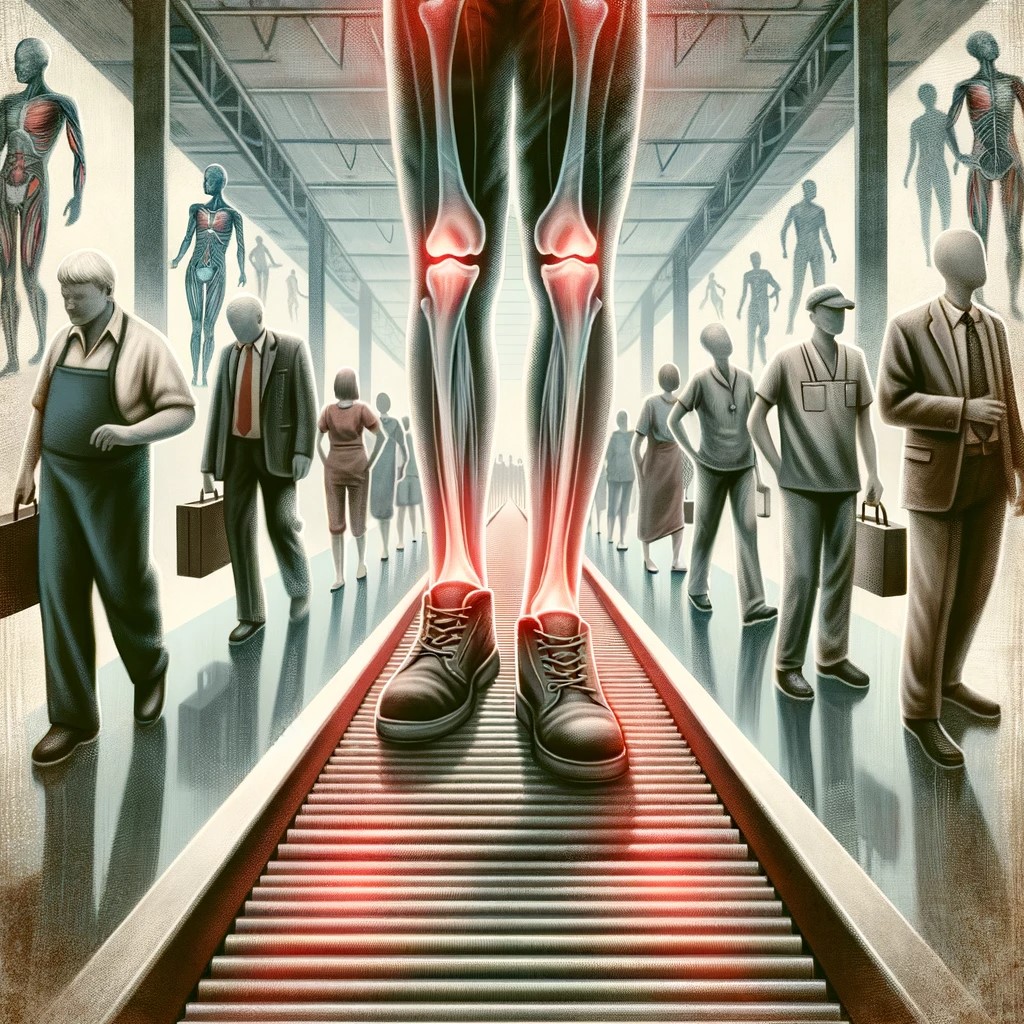
The effect on the nation’s health is serious. Standing for long periods causes or contributes to a variety of medical problems.
The consequences are not limited to a few aches and pains:-
People who primarily stand on the job are twice as likely to develop heart disease as people who primarily sit.
The Conversation.com – describing results from a study on the impact of occupational standing and sitting. Published August 2017 in Canada.
Industries Affected by Standing for Long Periods
Those employees who have to stand all day at work are often in lower-paid jobs such as retail, catering, and hospitality.
Among them are :-
- Retail staff.
- Assembly line workers.
- Security staff.
- Engineers.
- Catering staff.
- Library assistants.
- Hair stylists.
- Laboratory technicians.
Some of these employees cannot walk to ease the strain on their muscles. They have to remain in place until they are due for a break or it’s time to go home.
This can cause health problems for workers who have to spend a lot of time standing in one area as part of their duties.
Health Problems and Prolonged Standing at Work
Standing for long periods at work is bad for health because of the strain on the lower limbs. Problems include aching muscles, hazardous pressure on hip, knee and ankle joints, back problems and damaged feet.
Here are just some of the health problems caused by standing all day at work:-
Musculoskeletal Disorders
Prolonged standing at work causes a decrease in blood circulation and reduces nutrient supply to muscles, causing muscle fatigue. These decreases can result in lower limb Musculoskeletal Disorders (MSD’s).
The health issues caused by this include:-
- Leg fatigue, which also increases the likelihood of trips, slips and falls.
- Increased risk of lower back pain.
- Neck and shoulder pain due to reduced blood flow.
- Issues with blood circulation in the legs, which in turn can cause swelling and varicose veins.
- Other disorders which cause damage to veins in the legs, which can cause ankle and foot problems.
- Rheumatic disorders caused by lack of mobility around the spine, hips, knees, and feet. Standing for prolonged periods at work can cause joint danage and pain.
- Prolonged periods of standing can cause a reduction in joint lubrication. This can lead to issues with hips, knees, ankles, and feet for workers.
Commonly Reported Symptoms
Problems with feet include corns and bunions. Standing can also lead to flat feet and heel spurs.
The symptoms people usually experience from spending a lot of time standing during work are lower limb swelling, tiredness and discomfort.
Medical professionals also link standing to varicose veins and a condition known as chronic venous insufficiency (CVI). With CVI, veins cannot send enough blood to the heart.
Another serious condition associated with standing at work is coronary heart disease. Workers may not develop heart disease as a direct result of standing for long periods. But if they have an existing heart problem, standing for hours can make it worse.
Canadian studies make a further connection between ill health and standing. Back pain is twice as likely to occur in workers who stand for most of their working days rather than sit.
Other health issues related to standing include hip and knee arthritis, high blood pressure, and locking of joints.
UK Employment Law on Standing
The Workplace (Health and Safety) Regulations 1992 refer to standing. The law says that employers must supply suitable seats if workers are able to perform their duties, or a substantial part of them, sitting down.
No prosecution of an employer under this law has taken place. There have been five improvement notices served on employers. These notices have insisted upon seats for workers. All the employers complied. Compared with the number of employees who spend all day standing at work, this is a very low figure.
Employer’s Viewpoint of Standing at Work
Part of the reluctance to encourage workers to sit is down to the employers perception of how seated workers look to those visiting the business. Employers believe that staff who are standing create a better impression with customers.
In some instances, workers themselves may feel it’s rude to be sitting when dealing with members of the public. However, no one accuses professionals such as solicitors and doctors of being rude when they sit behind desks and see patients in their offices.
To make matters worse, health and safety researchers often fail to appreciate the damage standing causes. Professor Messing of the University of Quebec in Montreal is an expert in prolonged standing. She says researchers don’t take standing seriously because they work in an environment where they have the choice to stand, sit or walk away from their workstations. Many employees who stand all day don’t have this freedom.
Solutions to Prolonged Standing
Sitting down all the time at work is not a solution. Prolonged sitting also causes a range of health problems.
The best advice, endorsed by experts in the field, is to:
- Cut the time workers spend standing or walking.
- Arrange for work surfaces to have adjustable heights so workers can alternate sitting and standing.
- Arrange rest breaks with employers.
- Ensure adjustable chairs are available.
- Making sure posture is good and lifting and carrying tasks are carried out with care.
These goals are not necessarily easy to put in practice. Employers may have to make significant changes to workstations. But the long-term benefits can offer a good return on investment. One estimate, for example, says the UK loses two million working days a year because of lower limb disorders.
Our guide on how to deal with standing all day at work has practical hints and tips to stay healthy at work.
Anti Fatigue Mats & Footwear
The right flooring and footwear have roles to play as well. Hard concrete floors, a common feature in factories, are the worst of all surfaces to stand on for long periods. There is absolutely no flexibility to concrete. Carpeting, rubber, cork and wood are far better surfaces.
If these more suitable surfaces are impractical, anti-fatigue mats can help. These mats provide just the right amount of cushioning to make standing easier. They also have sloped edges to prevent trips.
Mats mustn’t be too soft, however. Soft mats can actually increase the feeling of tiredness in backs and legs.
As for footwear, this must be practical and comfortable. It should not pinch the feet or toes; insoles should be shock absorbing; and heels must be no higher than five centimetres.
Further Reading: Why do my feet hurt so bad after work? A detailed guide on work related foot pain, and how to alleviate it.
Standing at Work FAQ’s
Here’s some commonly asked questions from workers who are concerned about what prolonged standing.
Standing on concrete can cause several health conditions if done for prolonged periods. Commonly reported problems include back pain, bunions, and shin splints. It can also worsen pre-existing health conditions such as arthritis.


Is there a law how many hours will or can a 68 year old staff stand in a fitting room?
Hi there,
My girlfriend is a Pharmacist and it seems universal practice in all the pharmacies she works in that the pharmacist and most of the employees stand up all day long (9 hour shifts) doing jobs which could be done seated. They do walk around in the pharmacy a fair bit but there are long periods when they are standing still and could be seated.
She is almost crippled at present with plantar fasciitis in one foot and it’s starting in the other now. She’s seen podiatry and tried all sorts and after a year it’s almost as bad as it was in the beginning, and is starting in the other foot now.
When she takes a week or more off work, it starts to get better.
Would I be right in thinking this is a work related overuse injury?
I have suggested we get her a folding bar stool (ikea do a good one) which she can take into work to vary the pressures on her feet but ultimately it appears her employers need to be notified to sort this situation out. I have also suggested she talk to her union to get advice, before politely requesting some time off work to let it settle and then returning to work with a folding bar stool/ seat (the work surfaces are quite high, more like a worktop than a desk) so she can sit down all the time when she isn’t needing to walk around the pharmacy.
Do you have any advice on how to tackle this issue?
Thanks
Hi
I have had two partial knee replacements, one in 2019 and one in 2021. Yesterday I had to do a five hour shift at work which involved being stood in one area directing patients – Today I cannot walk, my knees are so painful and I’m really scared I’ve done some damage. What can I do?
Hi
I work in a factory for 12 hours per shift.
It’s concrete throughout we are provided with breaks.
However me and another member of staff sat on a pile of cardboard at around 4am and chatted for 5 mins.
The manager told us off saying it’s a matter of respect we shouldn’t be sat down Infront of him?
Is this true??
All work had been carried out we were simply taking a load off while waiting for our machines to produce things
Can anyone give me any information on the laws etc I work as a gateman on a construction site I start work at 06:30-17:00 with half hour break somewhere in that time but for my job I’m told to stand outside a gate no matter what the weather is with no shelter and not even a seat so as you can imagine 10 hours a day constant standing cold wet I’m sure this isn’t allowed especially for the company I work for it is massive and very well known
I work were you stand your entire shift. We had mats down which helped but they were removed because doctors complained about tripping over them. I suffer from foot problems and asked my manager if we could have the mats put back down because of my foot problems but I was told no. I’ve had to have surgery on my foot and ankle because of a torn tendon from pumping up a stretcher, and my foot problem has gotten worse to the point that I will never be able to work standing again and now I have to walk with a cane. I’m on long term disability from the surgery and now I’m disabled. My question is, can I take legal actions towards my employer for not providing reasonable accommodation for a comfortable, safe work environment and for not offering an alternative to the anti-stress mats that were removed because the doctors needs were being meet and not the other workers that worked 10+ hours standing while only getting a 30 min lunch break?
Hi Angela, In the first instance you should consider raising a grievance about the decision. To get more information about possible legal action, contact ACAS who will be able to help you proceed with your complaint properly and in a timely fashion. Certainly, if your employer has failed to make reasonable accommodations for your disability, there may be grounds to make a legal claim. ACAS can help you do this. Hope this helps.
Can you help!
I’m qualified chef want can l do to ease the pain. is my boss doing the right thing for my health.
Hi do front office workers need to stand and work 9-10 hour shifts specially working in a gym as receptionist
I work at an airport. We have recently had our breaks cut, whilst they are compliant with the law we have concerns. We get half hour but we have to walk to an area away from our workplace to have it. we spend 90% of our 9 hour shifts standing and the total time sitting on break is less than 20 mins. There is no where for chairs due to the operations. Any ideas what I can suggest to my employer? There is multiple foot, leg and other health issues in the workforce.
Hi I work in a fuel garage for 8-10 hours a shift standing behind a till and stocking shelves we did have a chair but the manager took it away and we aren’t allowed to use it. We work alone so breaks are none existent as we can’t come away from the till or shop floor. The flooring behind the till is worn away and very hard. I’ve only worked there a few month and already feel I’m getting flat feet. The pain in my feet after a shift isn’t pleasant. Is my manager being unreasonable is there anything we can do about this?
Hi Charlotte, that doesn’t sound ideal. Whilst the law says that employers must provide a chair if a job can be done sitting down, there have been no prosecutions of employers on this basis. However, you do have a right to an uninterrupted break during a shift of that length, and your employer should be taking steps to ensure you get one. If you can, remind your manager of your right to a break. Perhaps suggest that a chair could be provided to allow you to do this. Also, if you are being asked to stand you could request a mat to help alleviate the pressure on your feet. Hope this helps.
Thank you so much
Hi
My work has removed the outside smoking area seating during covid. We stand throughout our 8 hour shift and when we outside getting fresh air and/or having a smoke during our 30 minute break thats the only benches we have. Is this legal?
Hi Rita,
Unfortunately your workplace is not obligated to provide seating outdoors for smoking or staff breaks.
Hope this helps.
My workplace consists of a marble floor. Concrete on Mohs hardness scale, is usually around a 3. Whereas Marble is the next stage up for hardness, registering in at 4. My employer does not care one little bit regarding this, becoming disgruntled when staff sit down for a few minutes to rest their entire body during the odd short lived lull. While it is great that these laws and guidance exist, actually implementing them is a whole different matter entirely.
I work 12 hr shifts. We were allowed stools, but a new manager took them off the floor. We work in concrete flooring no mats and no due care to employees.
My partner is 63 standing at a till he’s doing a 5 hour shift today without a break although he walks around the store filling shelves when no customers are there my point is should he be entitled to a short break on this shift
Hi Rita, unfortunately entitlement to a break doesn’t kick in until a 6 hour shift is being worked. Many employers will tailor shift lengths to account for this to simplify their rotas.
I work behind a bar. I suffer from a torn muscle in my lower back and need to sit occasionally. I’ve been told I’m not allowed to and need a fit for work note. Is this correct? Thanks
Hi Rita,
The best course of action is to get the fit for note work from your doctor. Your employer will then have the offical document that says you need this adjustment to help you carry out your job. Hopefully once you provide them with the note, they’ll make the adjustments the doctor suggests to help your back.
For sciatica try a chiropractor- it worked for me. Otherwise epsom salt baths help but dont solve it.
My husband works in a petrol station. He works 3, 8 hours shifts. In those 8 hours he has no breaks as management states that employees must be 100% productive, 100% of the time. He literally stands for 8 hours straight. He is the only male working there and so he has to put all the stock away himself. The company has now taken on more staff than there are shifts and he is worried that they will get rid of him as he is 2 years off retirement. The local council has visited the shop and mentioned it but state there is nothing they can do to help the situation. Is this right? Or is the council worker misleading him?
Why employers are so paranoid about people in the sitting position is weird.
It is so sad to read about the workers who are working for long hours standing with pain. I really felt very sad after reading the pains of a pregnant woman too. Seriously, some steps need to be taken to safeguard them, as they have to take care of the company and their family including themselves too. There will be a way. I am a researcher in Computer Injury Prevention Techniques and will be happy to share my research with the Governments. Let’s work happily ??
Look at a pharmacy – they never allow their employees to sit down. Why is nobody doing anything about that?
I work 8 hrs standing and a pregnant, my feets are extremely swollen. I work in ware house and I dont want to lose my job because it sustains me and my family.
I work 12 hour shifts days and nights from 6 till 6 and I am expected to walk around on a concrete floor with only 45 minutes break in between is this bad for my mental health as well as my body a chair that was provided has now been taken away is there anything I can do
Hey, I work as a pharmacy assistant and Im honestly finding work painful at the moment. I can handle the slightly short shifts but I usually am working 6-9 hrs at once. Its really affecting me, as Im not aloud to sit at all, walk around or even slouch. Its so painful, and Ive tried everything (shoes, baths, physio) and nothing helps. Then I face constant abuse from customers and sometimes from management. Its so upsetting and sometimes I have to use my toilet break to just cry. All this on top of the fact that I have into stand in one place all day, where I probably serve people only about 10% of that time. Im not allowed to read, sit, talk to other employees, or keep myself busy. Its so boring I cant function. It sounds silly but every second is painful. And I only get one break, sometimes not even 30 mins. Im so tired and I need advice.
I work for one of the richest men in the world ..whos name you see everywhere. I work in his distribution center working 4 days 10 hr shifts that’s a normal work week except when Prime starts then I feel like I live there. Concert floors yes but we have mats at our work stations. My body has really been taking a toll. My legs, feet and definitely my knees hurt. I know it’s a labor job. But it pays my bills and keeps a roof over my head. I wish there was a miracle pill I could take my pain away. But my boss is working putting his rocket ship into space for everyone.
Snap I work in amazon 2 and honestly they don’t seam to care I notice leads, hr and above have chairs but those doing pack, stow don’t get chairs or perching stools to take some pressure off the feet, let’s be honest if companies got into trouble because of prolonged standing in the workplace would change drastically which while.they have people who dont think about long term health effects they don’t care, I suffer from plantar what ever its called also got some early warning signs for diabetes foot pain is near unbearable atm managing with painkillers and anti inflammatorys what can be done im due a occ health meeting gonna try getting doctor to write a letter and podiatrist but work places need to change
I worked at least 10.5hrs, sometimes 11hrs, 12 hours and occasionally 13hrs daily, 30-31 days every month or 26-27 days some fewer months. I got paid only £5/hr. Absolutely no holiday pay and actually no holidays at all even Christmas, Easter, New year, BH and what have you. No annual leave or any form of Leave whatsoever. No NI or pension contribution on my behalf and totally very wicked disregard for my humanity. I’ve actually been fired. I have no one to complain to, but my case will be televised for the world to see because I will send my boss back to Satan and go to jail or make sure I followed him to Hades to make sure we both burned thoroughly. Thank you.
I stand on my feet 8 hrs a day Im suffering from sciatica any hints to do make more easy day.
I work for 8 hours a day stood at a desk on a concrete floor, sticking labels into clothing. I work Sunday – Thursday 2pm – 10pm with an half an hour break at 6pm. My feet are starting to kill me more and more each day to the point where Im struggling to walk at home. I dont know what to do because I really need this job but I think we should at least be allowed to sit down.
I work in the A&E department of a hospital as a porter and we do 12 hour shift and walk around 14 miles on average a shift but down time is a massive part of our duties at times but we are meant to stand around waiting for a call, are we entitled to a base where there are suitable seating for us when we have got down time
We use to sit down at are jobs , now they makes us stand up,over 25 yrs I been back suffer , disgentive from neck to tailbone.now standing is affects me more ,weak soreness and fatigue, is there any help out there to help with this problem
would this instance still apply, if i was to be asking for the flexability to work standing up at my work place desk, as i have been reading that sitting for too long a a computer station is just as bad as standing for long periods.
Hello. I have been searching online for help and can’t seem to find any info so Im hoping someone here could help me. Recently started a new project at work. (I work in a factory producing moulds for cars mainly rubber) Anyway with the new project they have installed new work stations. And I have complained for the past 2months that they are too low for me. After about 3 weeks I starting getting a pain in my neck, like a stiff neck, still complaining and now also about the pain it’s causing and still nothing has been done. I ended up going to the doctors receiving painkillers and advised to have some time off to rest my strained neck. Rested my neck felt better again gone back to work they now said they will set up an investigation into it asking my height and what was hurting etc. And sent back to my work station nothing has changed it’s still too low and two more weeks later and I’m in pain again with my neck. Looking forward to another weekend in pain and who knows how much worse it will get and they don’t seem to be doing anything. Is their legal requirements or regulations for how high my workstation should be? There is 3 of us that work this machine along with the workstation to trim, sign and finish the parts. The other guys are much shorter than me. Should the work station be height adjustable to suit the 3 of us individually? Any more time off and I will end up losing my job as they are very strict on absences. Yet at the same time they’re not helping me and I dont know what to do. Please any help would be appreciated. Many thanks
Hi i was wondering if you can help me out on this. I work in a cold food plant on an 8 hour shift … and we have 2 rest breaks and a lunch break … rest breaks are 20 min and lunch is 35…. how long before my first rest break ?? is it 2 to 3 hours or is it 5 hours ???
I work as a chef and we it’s long hours. Its 10-3 5-10. We have to stand all through the shift. I am pregnant and suffer with varicose veins and pgp ( pelvic gridle pain ). The doctor has advised me to make sure I’m not standing for hours at a time as it will not help my condition and could worsen it which will make me end up on crutches and to be put on sick. The owner today has took me into the office with our pr representative and had ago at me over it. Tried to explain to my boss and she wasn’t listening to me and threatened to cut all my hours and told me pregnancy isn’t an illness which 9I have never stated that it is. I tried to explain that I only sit down when all of the other chefs go for a cigarette break so not to annoy anyone and she has completely blown up and made me feel like my job is at risk. What should I do ?
Hello, my wife works as a hotel receptionist and she has dine for the past 12 years. There has been a change in management and there new manager is taking away all seats in the reception area where the computer’s are and she and the other receptionist have to stand up for a good 8 to sometimes 10 hours with out sitting down. Please can someone tell me if this is legal in anyway, plus my wife has sciatica there is only so long she can stand up for with put her back hurting.
I stand for 7 hrs a day st a press as I work in a dry cleaners, sometimes I barely leave etc to use the toilet, I am in constant pain in my feet legs back and wrists, I stand on a hard floor and Im so fatigued at the end of the day that I end up in tears Im 62yrs old and Ive got 4more years before I can retire how can I get more help
Thankyou for all this info need it for my sister
Could you tell me i am wearing an immobilizer knee brace having to work i stand 8 hr shifts is there a law against that
Hi I work for a busy café, the last year we have had some major redevelopment in the way we work. Just recently I found myself doing 8 hour shifts standing within a meter square area, I have no support from the other team members and i also have a short break towards the 7 hour mark. I’m in constant pain in my back legs and groin and im looking for advice how to approach the matter as the team leader has made out I’m exaggerating the matter.
I am a receptionist for a hotel where standing is a must. They have provided a stool with no back support to rest on between guests to aid, however I have a disability that they are aware of which cause chronic fatigue, joint pain and inflammation and can lead to heart failure and heart cancer in the future. As I said they are well aware of this and are threatening to remove the stool because I rely too heavily on it and are constantly reprimanding me for sitting out of view of the guests in a normal desk chair to relieve my back pain caused by sitting on the stool. I don’t know how I can get across to them that I physically am unable to do my job properly because of this.
Working in production on a cold ground and on your feet eight hours packing place is cold Ive severe pain in my legs is there anything I can do I can barley walk the next day and boss just laughs ??
I’m working in garments for 8 hours without sitting so it will appen to me something to my health
I work in a fish and chip shop can I wear a sleeveless top or Must I have my arms covered
I work in a food factory and work 12 hour shifts for 10.5 hours of the shift I’m standing on a metal floor which is 5 ft hight on a machine can there be anything done to make it more easy on joints and back
I work at the airport 9 hours shift. I have 2 hours work and 30 mins break, 3.5 hours work and 1 hour break and last 2 hours work. Except that 1,30 break i am not allowed to sit. I am not allowed to keep water around me. It is busy environment and noise sometimes is unbreable. Lighting is too much, and I have to look at the screen while I am on duty. I just want to know if there is regulations about the distance to water supply, or lightings?
I work in security and I’m suppose to be on my feet all day because apparently it looks “professional” exact words of the manager, Think I listen psshhh, Health over wealth buddy, just bring up a pay rise topic and they’ll walk away??