
Accidents at work can happen to anybody at anytime. In certain environments, specific types of accidents and injuries can be more common than others. For example, you’d be more likely to suffer burns or breathing problems from working with Dangerous Substances than if you worked in an office. Our accidents at work examples grid will highlight the most common causes of workplace injuries.
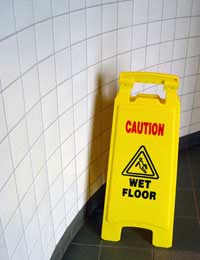
Accidents at work will occur from time to time but the employer has a duty of care to assess and minimise the Risks at Work as much as possible. A large number of accidents can often be put down to employer negligence. Our guide to common workplace injuries and their causes will help clarify what needs to be looked at in a workplace risk assessment.
Accidents at Work Examples – Most Common Injuries & Causes
Some accidents occur more frequently than others with varying consequences:
| Slips & Trips | Manual Handling | Workplace Traffic | Electrical | Chemical / Fire | Plant & Machinery |
|---|---|---|---|---|---|
| Head & back injuries | Muscoskeletal injuries | Fractures & Fatalities | Electric Shock | Severe Burns | Amputations & Fatalities |
Slip & Trip Accidents at Work
It has been reported that almost a third of the total of workplace accidents in the UK are the result of slips and trips. In a vast number of these instances, the accident has occurred in wet or contaminated conditions.
Most trips are put down to bad housekeeping. This might be where substances were left on the floor, obstructions, adverse weather and poor flooring have been the cause.
Slips trips and falls at work can seem minor – it can even be a source of humour to some. But the reality is that these types of fall at work can result in head injuries, broken bones and major fractures to limbs and even death where the fall is from height.
To Avoid Slips & Trips Accidents Employers Should Ensure:
- Flooring is suitable and worn flooring is replaced.
- If ice is prevalent outdoors, it is cleared and the area is sanded or gritted.
- Trailing cables are hidden away.
- Flooring is cleaned regularly using appropriate cleaning materials.
- There are adequate hand rails, guard rails and sufficient lighting in place.
- Areas that are temporarily wet or slippery are clearly marked.
Manual Handling Accidents at Work
Around a third of all workplace accidents reported to the Health & Safety Executive happen as a result of Manual Handling mistakes.
The term is used to describe any activity that includes lifting, lowering, pushing, pulling, carrying, moving, holding or restraining an object, animal or person. The majority of injuries are musculoskeletal to backs. Although strains to hands, arms, feet, tendons and the heart are also reported each year.
To Avoid Manual Handling Accidents Employers Should Ensure:
- Carrying is not undertaken over long distances.
- Lifting or carrying does not require extensive twisting, stooping or reaching upwards.
- Lifting or carrying does not require any strenuous pushing or pulling.
- You are not required to carry anything where load movements can be unpredictable, unstable or difficult to grasp.
- Lifting is done by heavy goods lifting equipment where possible.
- Your work allows for sufficient rest periods where manual handling is involved.
- You are provided with manual handling training on good lifting practice.
Traffic Accidents at Work
Workplace traffic accidents occur not only in the traditional confines of a warehouse depot with heavy goods vehicles but in any place of work where people can come and go in motorised vehicles.
Common accidents include being struck by a moving vehicle, falling from, or materials falling from, a vehicle and the collapse or overturning of a vehicle.
Employers should try to make sure they:
- Keep pedestrians and vehicles apart using barriers or distance.
- Minimise reversing, introducing one-way systems if appropriate.
- Reduce the risks of falls from vehicles.
- Ensure workers who are drivers are properly trained.
Electrical Accidents at Work
Each year, workers lose their life as a result of suffering an electric shock in the workplace. This is not necessarily just those who work as electricians or with electrical equipment in general. Electrical burns are also a common cause of injury.
Employers should make sure that:
- All electrical equipment is well designed, appropriate for the job and well maintained.
- Staff using electrical equipment are fully trained.
- They give proper warning of any electrical hazards.
- Equipment which has safety cut out devices is used.
- Safe working practices are promoted.
Other Areas of Risk For Workplace Accidents
The areas mentioned are probably the main causes of the most frequent accidents in the workplace in general. However, other areas to be aware of include working:
- With hazardous chemicals.
- Where fire is present.
- With plant and heavy machinery.
- In enclosed spaces.
Whilst accidents can never be predicted, both employers and employees have a duty to minimise the risks as much as possible. Employers are legally bound to carry out a full Risk Assessment of possible accidents that might occur in the workplace and to incorporate preventative measures in their health and safety procedures.
If there is an accident, it should be thoroughly documented and investigated. Our guide to workplace accident investigation techniques will help. A good investigation after an incident can help make the work area safer.
Employees also have a duty to understand their company’s health and safety procedures fully and to pay due care and attention to their own actions in the workplace to minimise the potential of accidents as much as possible. These accidents at work examples should serve as a solid foundation to creating a risk assessment in a workplace.
You can read more on common causes of workplace accidents in our easy to understand guide. It makes light work of understanding key areas of risk, and statistics on types of accidents that happen in the workplace.


This article has really been helpfull to me and my classmates
Thanks for the information, it really help me very well please keep the update
this article has really been of help thanks ^_^
thanks for exelent information so mthat we have a learn today about that.
This article has really been of help
what are any intense work problems
Thanks for excellent information – it is really great.